My Setup / Overview #
I’m using the following setup:
- Debian 13
- NVIDIA 5070 Ti
- k3s version v1.36.6+k3s1
- Cilium version 1.20.4
- kgateway Helm chart version v2.5.1
Jupyter Helm Overview #
# Add JupyterHub Helm repository
helm repo add jupyterhub https://hub.jupyter.org/helm-chart/ &&
helm repo update
# List available versions of the chart
helm search repo jupyterhub/jupyterhub --versions

# Shell output:
NAME                    CHART VERSION   APP VERSION     DESCRIPTION
jupyterhub/jupyterhub   4.4.5           5.5.5           Multi-user Jupyter installation
jupyterhub/jupyterhub   4.4.4           5.5.4           Multi-user Jupyter installation
...
# Save Helm chart values
helm show values jupyterhub/jupyterhub --version 4.4.5 > jupyterhub-values-4.4.5.yml
Ansible Setup #
Playbook #
- k8s_jupyterhub.yml
---
- name: JupyterHub Helm installation
  hosts: localhost
  connection: local
  gather_facts: false
  become: false
  environment:
    KUBECONFIG: "{{ lookup('env', 'HOME') }}/.kube/k3spc1.yaml"
  vars:
    # Helm Configuration
    helm_repository: "https://hub.jupyter.org/helm-chart/"
    helm_chart: "jupyterhub/jupyterhub"
    helm_chart_version: "4.4.5"
    helm_release_name: "jupyterhub"
    kubernetes_namespace: "jupyterhub"
    # Storage Configuration
    kubernetes_storage_class: "local-path"
    kubernetes_pvc_size: "10Gi"
    # Routing Configuration
    jupyterhub_hostname: "jupyterhub.jklug.work"
    gateway_name: "kgateway-metallb"
    gateway_namespace: "kgateway-infra"
    gateway_section: "https"
    # JupyterHub Configuration
    notebook_image: "quay.io/jupyter/pytorch-notebook:cuda12-latest"

  roles:
    - k8s_jupyterhub
# Run playbook:
ansible-playbook playbooks/k8s_jupyterhub.yml
Role #
tasks/main.yml
- name: Create namespace
  kubernetes.core.k8s:
    api_version: v1
    kind: Namespace
    name: "{{ kubernetes_namespace }}"
    state: present


- name: Add Helm repository
  kubernetes.core.helm_repository:
    repo_name: jupyterhub
    repo_url: "{{ helm_repository }}"
    repo_state: present


- name: Install Helm Chart
  kubernetes.core.helm:
    name: "{{ helm_release_name }}"
    chart_ref: "{{ helm_chart }}"
    chart_version: "{{ helm_chart_version }}"
    release_namespace: "{{ kubernetes_namespace }}"
    create_namespace: false
    wait: false  # Ansible waits till all resources are ready
    wait_timeout: 3m0s
    atomic: false  # Auto-rollback on failure
    values: "{{ lookup('template', 'helm-values.yml.j2') | from_yaml }}"


- name: Allow JupyterHub hub to reach the Kubernetes API (Cilium policy)
  kubernetes.core.k8s:
    state: present
    definition:
      apiVersion: cilium.io/v2
      kind: CiliumNetworkPolicy
      metadata:
        name: hub-to-kube-apiserver
        namespace: "{{ kubernetes_namespace }}"
      spec:
        endpointSelector:
          matchLabels:
            component: hub
        egress:
          - toEntities:
              - kube-apiserver


- name: Enable WebSocket upgrades on the gateway (Gateway policy)
  kubernetes.core.k8s:
    state: present
    definition:
      apiVersion: gateway.kgateway.dev/v1alpha1
      kind: ListenerPolicy
      metadata:
        name: http2-websocket
        namespace: "{{ gateway_namespace }}"
      spec:
        targetRefs:
          - group: gateway.networking.k8s.io
            kind: Gateway
            name: "{{ gateway_name }}"
        default:
          httpSettings:
            upgradeConfig:
              enabledUpgrades:
                - websocket
Templates #
proxy:
  service:
    type: ClusterIP

singleuser:
  storage:
    type: dynamic
    capacity: "{{ kubernetes_pvc_size }}"
    dynamic:
      storageClass: "{{ kubernetes_storage_class }}"

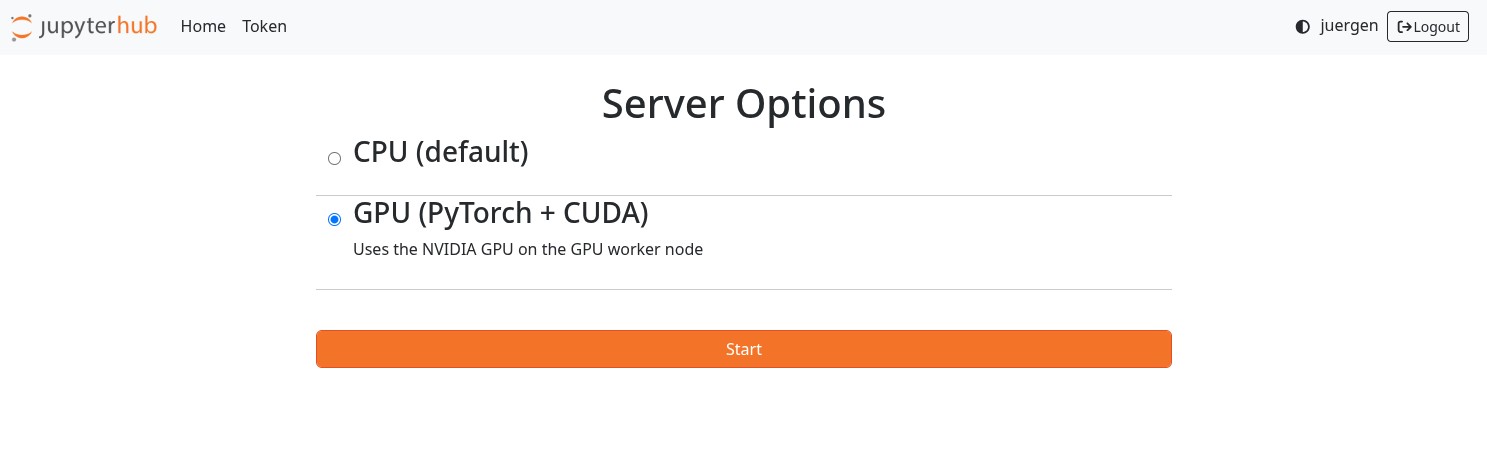
  profileList:
    - display_name: "CPU (default)"
      default: true

    - display_name: "GPU (PyTorch + CUDA)"
      description: "Uses the NVIDIA GPU on the GPU worker node"
      kubespawner_override:
        image: "{{ notebook_image }}"
        extra_resource_limits:
          nvidia.com/gpu: "1"
        extra_pod_config:
          runtimeClassName: nvidia

httpRoute:
  enabled: true
  hostnames:
    - "{{ jupyterhub_hostname }}"
  gateway:
    name: "{{ gateway_name }}"
    namespace: "{{ gateway_namespace }}"
    sectionName: "{{ gateway_section }}"
Webinterface #
Webinterface: https://jupyterhub.jklug.work
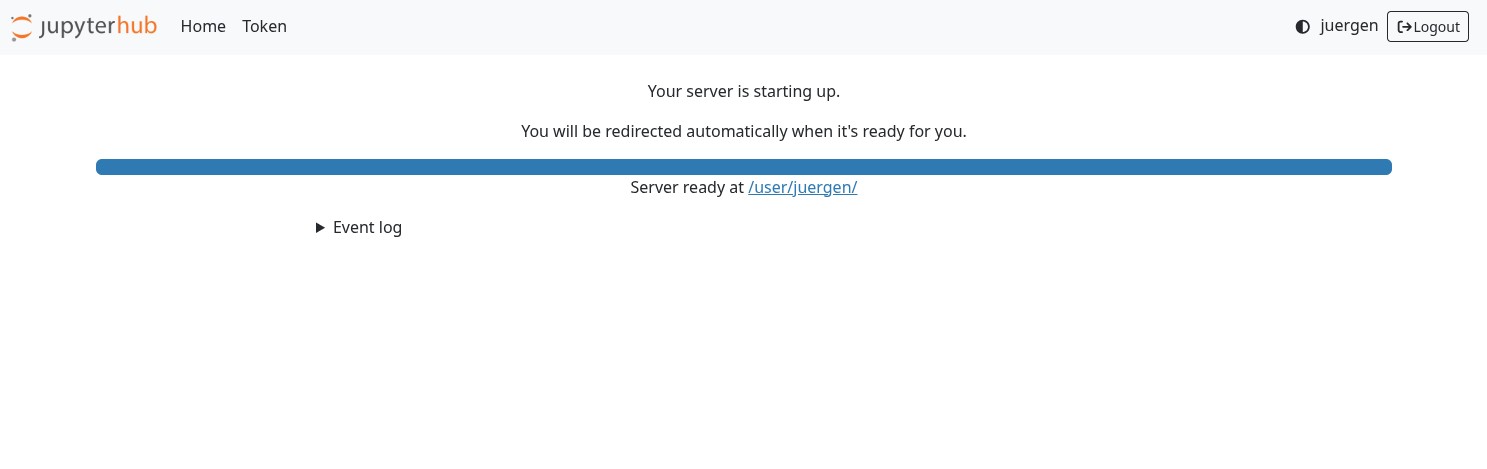
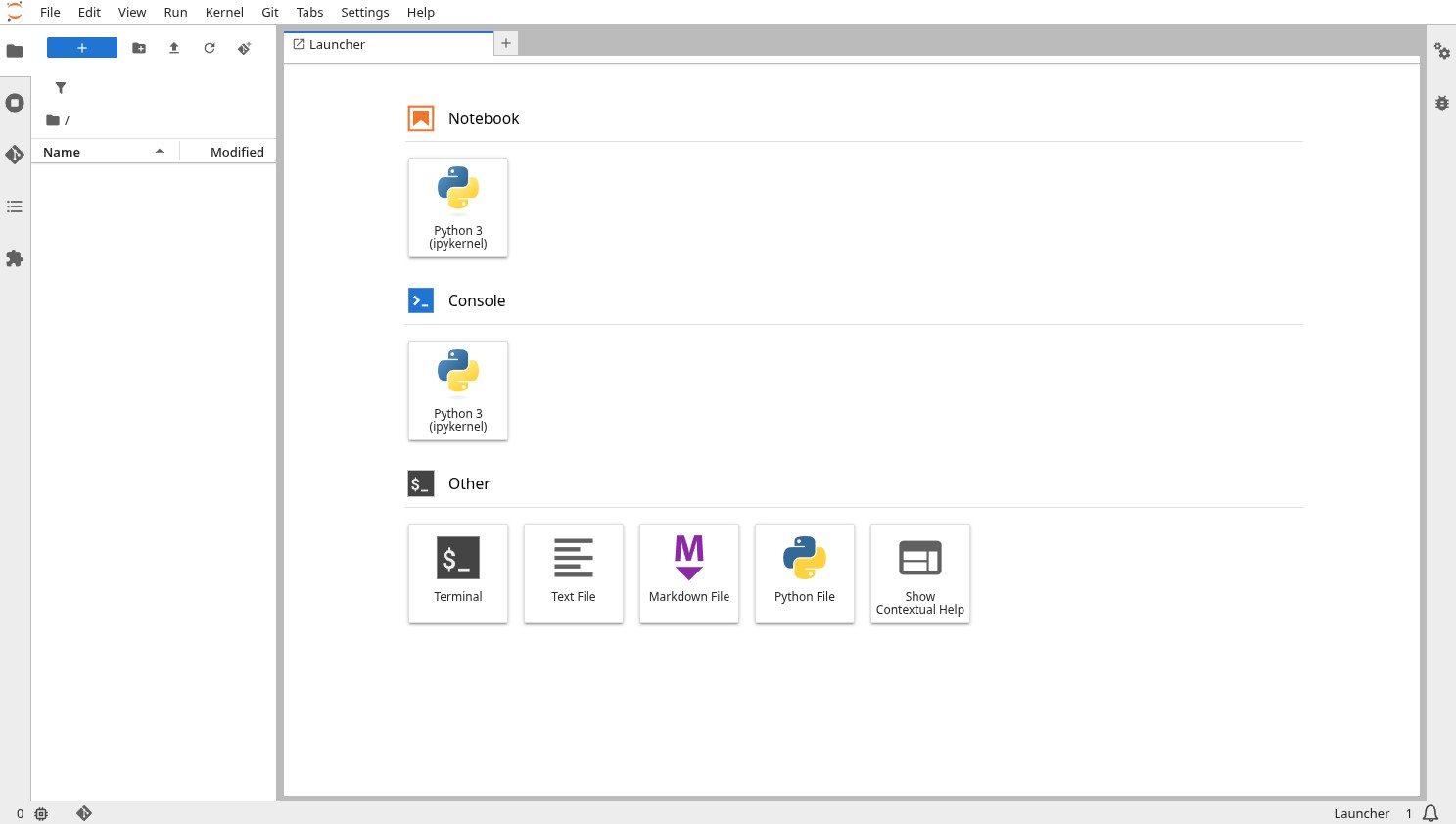
- With the dummy authenticator any user/pw can be used
- Login with a random username and pw like
juergen
Kubernetes Resources #
After Helm Installation #
# List default resources
kubectl -n jupyterhub get all

# Shell output:
NAME                                  READY   STATUS    RESTARTS   AGE
pod/continuous-image-puller-2l89t     1/1     Running   0          35s
pod/hub-574d769f56-qzhvm              1/1     Running   0          35s
pod/proxy-744fb5d8b4-24kd6            1/1     Running   0          35s
pod/user-scheduler-7d98d84496-5gczw   1/1     Running   0          35s
pod/user-scheduler-7d98d84496-7q9ts   1/1     Running   0          35s

NAME                   TYPE        CLUSTER-IP       EXTERNAL-IP   PORT(S)    AGE
service/hub            ClusterIP   10.201.238.144   <none>        8081/TCP   35s
service/proxy-api      ClusterIP   10.201.119.179   <none>        8001/TCP   35s
service/proxy-public   ClusterIP   10.201.73.25     <none>        80/TCP     35s

NAME                                     DESIRED   CURRENT   READY   UP-TO-DATE   AVAILABLE   NODE SELECTOR   AGE
daemonset.apps/continuous-image-puller   1         1         1       1            1           <none>          35s

NAME                             READY   UP-TO-DATE   AVAILABLE   AGE
deployment.apps/hub              1/1     1            1           35s
deployment.apps/proxy            1/1     1            1           35s
deployment.apps/user-scheduler   2/2     2            2           35s

NAME                                        DESIRED   CURRENT   READY   AGE
replicaset.apps/hub-574d769f56              1         1         1       35s
replicaset.apps/proxy-744fb5d8b4            1         1         1       35s
replicaset.apps/user-scheduler-7d98d84496   2         2         2       35s

NAME                                READY   AGE
statefulset.apps/user-placeholder   0/0     35s
# List HTTPRoute
kubectl -n jupyterhub get httproute

# Shell output:
NAME         HOSTNAMES                   AGE
jupyterhub   ["jupyterhub.jklug.work"]   41s
# List PVC
kubectl -n jupyterhub get pvc

# Shell output:
NAME         STATUS   VOLUME                                     CAPACITY   ACCESS MODES   STORAGECLASS   VOLUMEATTRIBUTESCLASS   AGE
hub-db-dir   Bound    pvc-320191fa-5704-46b6-a2fe-43decce5c1ef   1Gi        RWO            local-path     <unset>                 52s
Verify Hub pod Label for NetworkPolicy #
# Verify label
kubectl -n jupyterhub get pod -l component=hub --show-labels

# Shell output:
NAME                   READY   STATUS    RESTARTS   AGE   LABELS
hub-574d769f56-qzhvm   1/1     Running   0          70s   app.kubernetes.io/component=hub,app.kubernetes.io/instance=jupyterhub,app.kubernetes.io/name=jupyterhub,app=jupyterhub,component=hub,hub.jupyter.org/network-access-proxy-api=true,hub.jupyter.org/network-access-proxy-http=true,hub.jupyter.org/network-access-singleuser=true,pod-template-hash=574d769f56,release=jupyterhub
After User Login #
# List PVC
kubectl -n jupyterhub get pvc

# Shell output:
NAME            STATUS   VOLUME                                     CAPACITY   ACCESS MODES   STORAGECLASS   VOLUMEATTRIBUTESCLASS   AGE
claim-juergen   Bound    pvc-928e8980-192e-42d6-ac53-a0ac1331b76c   10Gi       RWO            local-path     <unset>                 77s
hub-db-dir      Bound    pvc-13a2e540-496f-4037-9dca-85a906676c9a   1Gi        RWO            local-path     <unset>                 7m34s
# List default resources
kubectl -n jupyterhub get pod

# Shell output:
NAME                              READY   STATUS    RESTARTS   AGE
continuous-image-puller-2l89t     1/1     Running   0          7m37s
hub-574d769f56-qzhvm              1/1     Running   0          7m37s
jupyter-juergen                   1/1     Running   0          80s  # Check
proxy-744fb5d8b4-24kd6            1/1     Running   0          7m37s
user-scheduler-7d98d84496-5gczw   1/1     Running   0          7m37s
user-scheduler-7d98d84496-7q9ts   1/1     Running   0          7m37s
Run Notebook #

# Verify CUDA and GPU
import torch
print(torch.cuda.is_available())
print(torch.cuda.get_device_name(0))

# Shell output:
True
NVIDIA GeForce RTX 5070 Ti
# Run NVIDIA-SMI
!nvidia-smi

# Shell output:
Sun Nov 22 14:07:53 2026
+-----------------------------------------------------------------------------------------+
| NVIDIA-SMI 595.112.07             Driver Version: 595.112.07     CUDA Version: 13.2     |
+-----------------------------------------+------------------------+----------------------+
| GPU  Name                 Persistence-M | Bus-Id          Disp.A | Volatile Uncorr. ECC |
| Fan  Temp   Perf          Pwr:Usage/Cap |           Memory-Usage | GPU-Util  Compute M. |
|                                         |                        |               MIG M. |
|=========================================+========================+======================|
|   0  NVIDIA GeForce RTX 5070 Ti     On  |   00000000:01:00.0 Off |                  N/A |
|  0%   34C    P8             12W /  300W |       4MiB /  16303MiB |      0%      Default |
|                                         |                        |                  N/A |
+-----------------------------------------+------------------------+----------------------+

+-----------------------------------------------------------------------------------------+
| Processes:                                                                              |
|  GPU   GI   CI              PID   Type   Process name                        GPU Memory |
|        ID   ID                                                               Usage      |
|=========================================================================================|
|  No running processes found                                                             |
+-----------------------------------------------------------------------------------------+